
AI packaged food photography needs more than a recognizable box beside an appetizing plate. A shopper may be asking what the mix makes, how much of the finished batch is shown, or which parts of the meal they must add. A convincing generated serving cannot answer those questions from packaging alone.
Build a short chain of evidence: what went into preparation → what actually came out → how much appears in the photograph. This guide gives you a reusable production sheet, a decision tree and three failure analyses for keeping those quantities connected.
All worked examples below are hypothetical. We have not cooked these examples, run model tests or verified generated food against physical products. This is visual-production guidance, not nutrition-label, health-claim or food-safety advice.
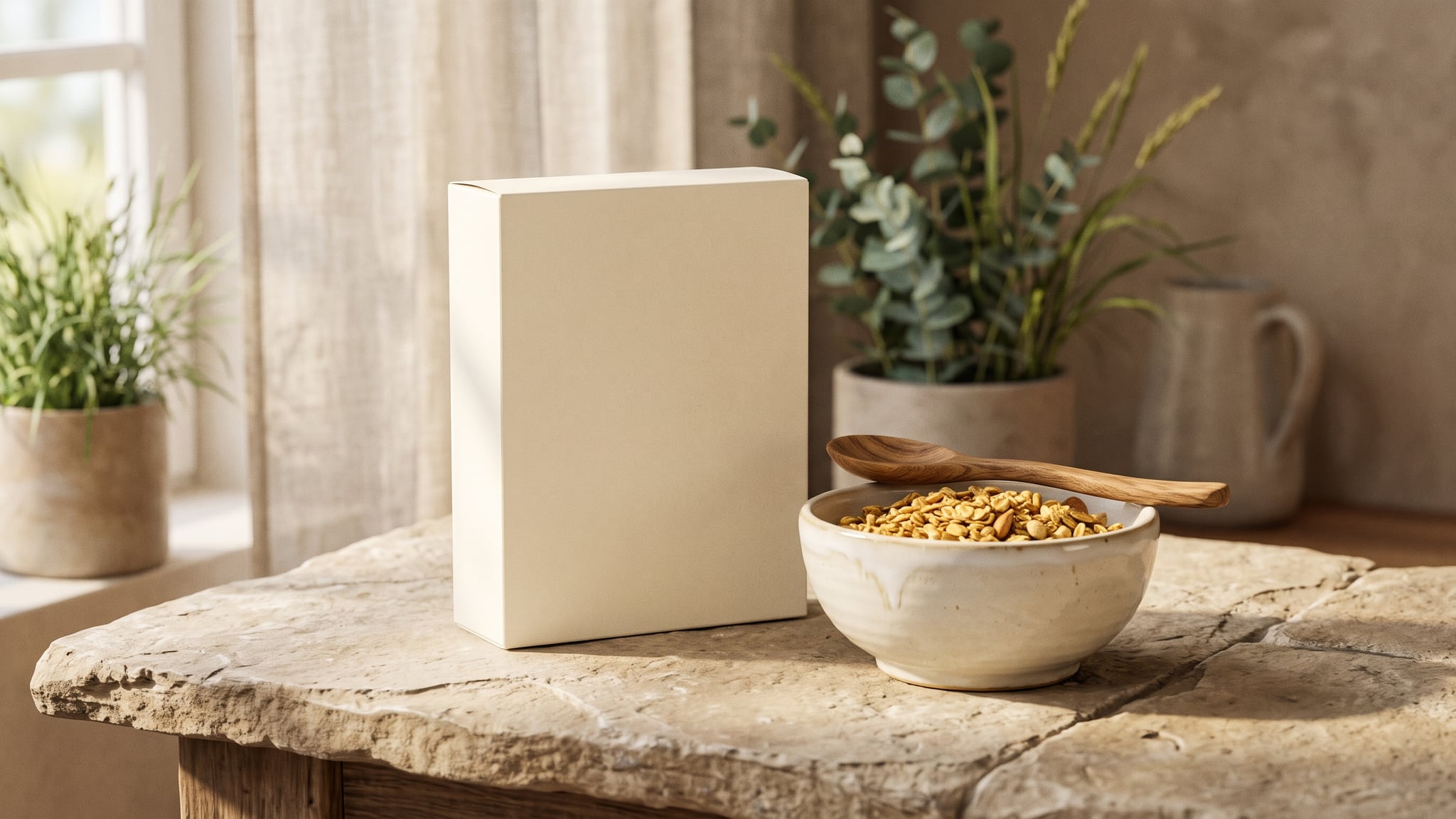
Conceptual AI illustration of a fictional cereal box, a bowl of cereal and a wooden spoon. It does not document an actual preparation, measured yield or portion.
Decide what the prepared-food image represents
Start with the image's job, not its styling. These three assets answer different questions:
| Asset | Buyer question | Evidence to retain |
|---|---|---|
| Product as sold | What arrives in the package? | Current SKU, pack photograph and actual contents |
| Prepared batch | What did this preparation produce? | Inputs, instructions, actual finished output and batch photograph |
| Pictured portion | How much of that preparation is on this plate? | Amount plated, source batch and original portion photograph |
A box of pancake mix is not a batch of pancakes. A batch is not necessarily one person's serving. The amount used for nutrition labeling is another quantity; do not derive it from a photograph or casually substitute it for the recipe yield.
For a concrete manufacturer example, Krusteaz's buttermilk pancake recipe lists one cup of mix and two-thirds cup of cold water for six to seven four-inch pancakes. That describes a recipe batch, not the whole package or a nutrition-label serving. It also does not establish the appearance of a particular stack you have not prepared.
Use this decision tree before generating
- Is the image only about the sealed product? Use a current packshot. Handle package details through the separate packaging and label accuracy workflow.
- Does it show prepared food, but you only have the package? Request or photograph the actual preparation. Keep invented food as an internal concept, outside the factual product gallery.
- Does the picture need to demonstrate the food's texture or quantity? Build around the real prepared-food photograph. A plausible resemblance is not evidence of that result.
- Are ingredients or sides added? Record them separately and review whether the placement clearly explains their role.
- Is a batch or portion claim unsupported? Remove the claim and any composition implying it, or obtain the missing preparation evidence.
The wider AI product photography guide covers scene creation. Here, the constraint is narrower: the scene must not invent the transformation between what is sold and what is served.
Record preparation for AI packaged food photography
Use the current SKU and the preparation instructions associated with it. Save a photograph or version reference for those instructions. If an alternate recipe is the subject, identify it as an alternate recipe rather than quietly presenting its result as the standard preparation.
Record the input in its original state: dry mix, frozen pieces, chilled contents or ready-to-eat food. Keep added water, milk, oil and other ingredients separate from the packaged product. Record the actual finished output instead of assuming it equals the sum of the inputs; preparation and transfer can change what remains available to plate.
Make the prepared reference useful for review. Capture the complete batch when a yield claim matters, then capture the portion intended for the final image. Keep a frame showing the dish and enough surroundings to understand its shape. Note the method and time between preparation and photography, especially when the food visibly changes while standing.
Guidance from Intake/FHI Solutions and the Federal University of Paraná distinguishes food state, form and presentation, recommends consistent dishes and capture conditions for portion series, and documents actual plated weight after excluding the plate. It was written for dietary surveys, not commercial photography. Our editorial adaptation is to measure and document the food you photograph, keeping comparisons consistent; it is not a mandatory advertising standard.
If you compare two preparations, change only what the comparison intends to demonstrate where practical. A thicker serving in a smaller bowl cannot isolate the effect of a different preparation method. Log deviations rather than presenting unmatched photographs as a controlled experiment.
Follow appropriate preparation and handling instructions. The production record helps explain a picture; it does not establish safe storage duration, nutritional content or suitability for a dietary restriction.
Build a preparation-to-photo sheet
Copy the following fields into a spreadsheet or your asset record. Keep unknown values marked unknown until someone supplies the evidence. Do not fill gaps with a model's estimate.
| Field | What to enter |
|---|---|
| Product and source | SKU, pack size, instruction source/version and shoot date |
| Starting state | Dry, frozen, chilled or ready to eat |
| Product input | Actual quantity used, with its unit |
| Added ingredients | Each addition and quantity, separate from product input |
| Preparation | Method followed and any departure from instructions |
| Finished batch | Actual output weight, volume or count, with the measurement basis |
| Pictured amount | Actual amount plated and the source batch it came from |
| Dish and timing | Plate/bowl dimensions and time after preparation |
| File trail | Original batch and portion filenames, candidate and export versions |
| Placement and review | Intended caption, page location, reviewer and approval decision |
Calculate only what the measurements support
Hypothetical worksheet: a fictional dry grain mix uses 180 g of packaged product plus separately recorded water. After preparation, the recorded finished batch weighs 480 g. The photograph shows 160 g taken from that batch, with no toppings.
The pictured fraction by weight is 160 ÷ 480 = one-third of that prepared batch. An internal note can say “160 g plated from batch B01; one-third by finished weight.” This does not make 160 g the recommended serving, prove a nutritional value, or establish what every preparation will yield.
Do not caption it “180 g serving”: that was the dry input for the entire batch. Do not describe the bowl as “the whole packet prepared” unless the packet quantity and full output support that statement. When the sheet cannot connect the pictured amount to the batch, the honest next step is another measurement or a less specific image brief.
For counted items, record count separately. Three pancakes out of six represent half by count, but not necessarily half by weight. A mixed dish also needs care: a plate with selected larger pieces is not automatically representative of every portion simply because its total weight matches.
Use the same measurement basis on both sides of any calculation. A dry weight divided by prepared volume is not a meaningful pictured fraction. Keep the calculation alongside the source files so a later crop or replacement image does not inherit an unrelated quantity claim.
Choose a production route that preserves the evidence
Once the record is complete, choose where generative work belongs. The decision depends on the source photograph and the intended claim, not on which route produces the most dramatic plate.
| Starting point | Practical route | Approval condition |
|---|---|---|
| Useful real portion photo | Explore restrained changes to surrounding scene | Compare returned food and dish against the original; reject unsupported changes |
| Real food must remain intact | Assemble the real photograph and separately generated surroundings in an external editor | Retain the photographed food and its meaningful context |
| Missing preparation or wrong state | Photograph the actual preparation again | Obtain evidence before making a factual prepared-serving image |
You can explore scene directions in Oxava, using available reference-capable models where appropriate. Reference input guides generation; it does not certify food weight, preserve every pixel or verify a recipe's yield. Review each candidate against the original before deciding whether it belongs in the product gallery.
For external assembly, a bounded photo panel can be simpler to review than a seamless reconstruction. If you cut out a dish, preserve the food within it and check that the new perspective and shadows do not contradict the photograph. Do not stretch the food to fit a layout or fill a partially empty bowl with generated pieces.
Changing the table is a different decision from changing the visible cooking result. Reject added browning, expanded pastry layers, larger inclusions or extra pieces when the actual reference does not support them. If the original cannot show the relevant texture clearly, capture a better real view rather than asking generation to supply the missing detail.
Diagnose three hypothetical serving-image failures
These are unperformed review exercises, not before-and-after tests or reports about specific products.
Pancake mix: an imagined stack becomes a yield claim
Available material: a packshot and instructions for a fictional mix. The concept shows nine thick pancakes beside the box, under the line “One batch, ready for breakfast.” No prepared reference exists.
Failure: the image implies a count and thickness that have not been documented. Reducing the stack to a number mentioned on the package would still leave its actual appearance unsupported.
Correction: prepare and record a batch. In a hypothetical completed record, six pancakes are produced and three are photographed. The image can then identify three pancakes from that preparation, with optional toppings recorded separately. Keep the whole-batch reference so the next editor does not mistake the three-pancake image for total yield.
Release decision: hold the imagined stack. Review the new real preparation and caption together before approving a replacement.
Ready meal: added rice makes the sold amount look larger
Available material: a real photograph of a fictional ready meal's contents. A candidate layout surrounds it with rice that occupies most of the plate. The rice is not supplied.
Failure: the prepared output and an optional side have merged into one apparent product quantity. A correct weight for the ready meal does not account for everything now shown.
Correction: retain an image of the actual contents for the product panel. If a separate recipe placement shows added rice, document that addition and make the distinction clear in both composition and copy.
A historical UK ASA ruling on Parsley Box, dated 13 November 2019, distinguished a small garnish beside a complete cottage pie from substantial sides that appeared included with other meals. The misleading-impression complaint was upheld despite serving-suggestion wording. This was a UK advertising decision, not Turkish law or a universal ban on garnish.
Release decision: reassess the whole placement rather than adding a tiny disclaimer. For the separate question of what edible props imply, see the coffee tasting-notes and serving-context guide.
Granola: a new bowl hides the quantity comparison
Available material: a hypothetical source photograph records 45 g of granola in a wide, shallow bowl. A candidate replaces it with a narrow, deep bowl and a fuller-looking surface.
Failure: the reviewer no longer knows whether the food was regenerated, the vessel changed or both. Fill height cannot establish grams, even when the caption still says 45 g.
Correction: retain the measured food and original dish, or photograph the same measured quantity in the proposed bowl. If milk or yogurt is added, record it as a separate ingredient rather than treating the combined bowl as 45 g of granola.
Release decision: reject the unsupported vessel swap. The product scale and size guide helps with geometry, but proportional review cannot recover unmeasured food weight.
Approve the export, caption and preparation record together
Review the final mobile crop as well as the master. A crop can remove the package, hide part of the batch or separate an explanation from the picture. Approval belongs to that complete placement, not just the attractive image file.
Before release, confirm:
- The current SKU matches the preparation record.
- As-sold input, finished batch and pictured portion remain distinct.
- Added ingredients are documented and explained where needed.
- Food count, texture and dish appearance remain supported by the source.
- Captions describe the actual photographed scope without inventing a standard serving.
- The exported crop, nearby copy and reviewer decision are saved together.
Track repeat work without assuming AI makes the shoot cheaper. A simple worksheet is preparation minutes + capture minutes + review minutes + external-composite minutes, with generation credits recorded separately. Log replacements and rejected candidates too. Use actual time entries for a completed job; label any planning estimate hypothetical. The cost-per-approved-image guide covers broader accounting.
AI packaged food photography is most useful when you can trace the prepared-serving image back to what was made and plated. Open Oxava to explore a restrained scene, then build the final placement around the documented food, its real photograph and an accurate caption.
Frequently Asked Questions
Can a packshot establish how the prepared food looks?
No. A package photograph identifies what is sold, but does not document the result of cooking or preparing it. Capture the actual prepared product under the instructions you intend to describe, and connect that photograph to its preparation record.
Does one recipe batch equal one serving?
Not necessarily. Batch yield describes the whole preparation, while the photographed portion may be only part of it. Neither automatically equals the serving used on a nutrition label. Keep those quantities separate and use verified product information for labeling questions.
Can AI estimate the pictured portion from pixels?
Do not use a generated image or visual guess as evidence of food weight. Hidden depth, density and dish shape make apparent volume an unreliable substitute for measurement. Record the actual photographed amount during preparation.
Does adding serving suggestion make every image acceptable?
No. The complete image and nearby copy still communicate what the buyer can expect. Explain optional additions clearly and change the composition when it implies unsupported contents or quantities; wording alone is not a universal solution.
Oxava Team
Egemen Küpçü is the founder of Oxava, with 10+ years of hands-on experience in 3D and visual production. He writes about the craft of generating product, brand and campaign visuals with AI.
Related Articles
ALL POSTS
Subscribe to our newsletter
Be the first to hear about new techniques, model updates and ideas on AI generation.